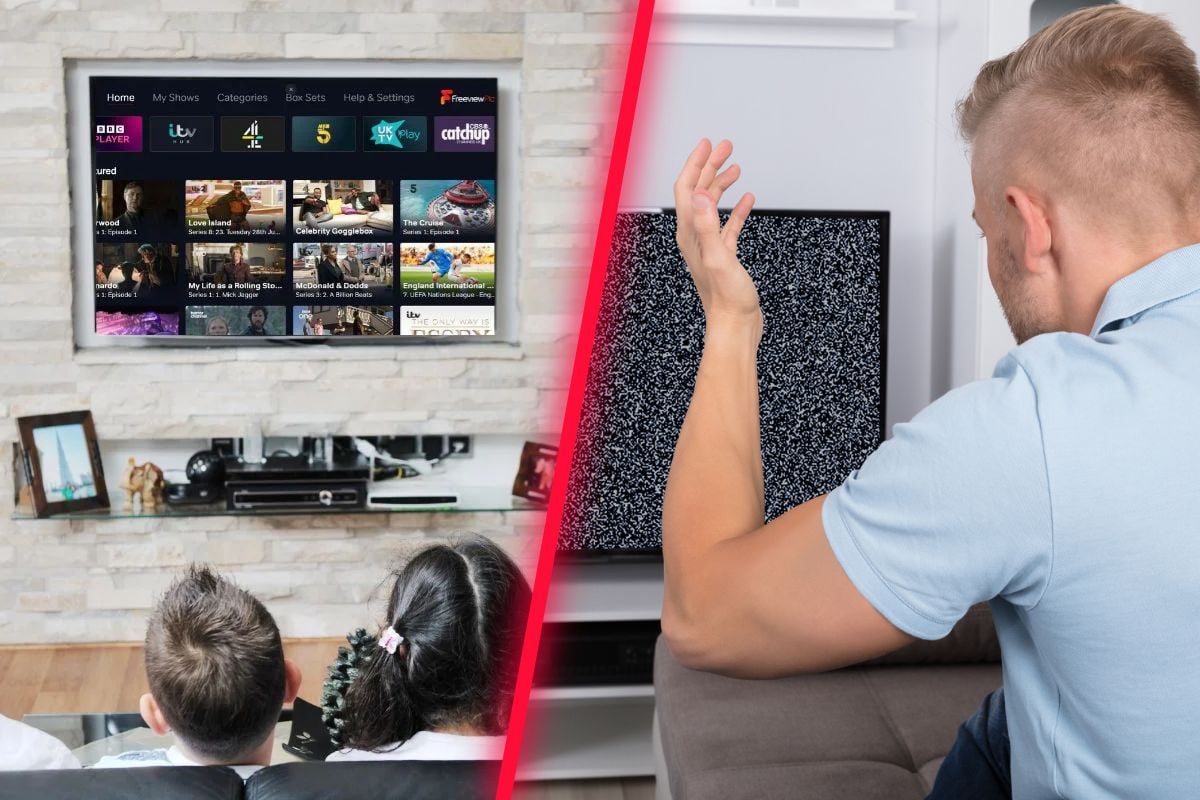

Freeview’s long-term future has rarely looked shakier than it does right now – but Arqiva, the company that runs the UK’s TV transmitters, has just put forward a detailed plan to keep it alive well into the 2040s, and it’s a plan that could end up shaping what happens to the aerial on your roof.
If you’ve been following along, you’ll know the pressure on traditional TV has been building fast. A couple of weeks ago we reported that the government is drawing up formal plans to switch off Freeview and Freesat, with a consultation document expected soon.
Days later came a fresh forecast suggesting Freeview could shrink to under a million homes by 2034, while its broadband-based successor Freely climbs to 10.5 million. The direction of travel has looked pretty much one-way.
Now there’s a voice arguing for the brakes. Arqiva – the company that operates Britain’s terrestrial TV and radio masts, which we’ve mentioned before as a backer of efforts to keep broadcasting going – has set out a specific, costed proposal for Freeview’s future.
And unlike a lot of “save Freeview” sentiment, this isn’t just a plea to leave things alone. It’s an actual blueprint, with numbers attached, for how free aerial TV could carry on for another two decades.
It comes as part of the BBC’s Royal Charter Review – the once-a-decade process where the government reworks the BBC’s funding and remit, with the current Charter running out at the end of 2027.
A committee of MPs asked anyone with a stake in the BBC’s future to submit written evidence, and while most of those submissions argued about the licence fee, Arqiva used theirs to make the case for keeping the transmitters running.
All the written submissions have now been published, so we can see exactly what they’ve proposed.
A Quick Recap: What’s Happening To Freeview?
Freeview – the service that delivers BBC One, ITV, Channel 4, 5 and dozens of other channels through your TV aerial – is facing an uncertain future, and so is Freesat, which does the same job through a satellite dish.
Between them, they still serve millions of homes with no monthly bill beyond the TV Licence, but the government has spent the past couple of years working out what to do with traditional broadcasting over the coming decade.
There are broadly three options on the table. Upgrade Freeview with newer technology and keep it running; strip it back to a bare-bones “nightlight” service carrying just the main channels for those who haven’t moved online; or set a date and phase out aerial TV altogether, shifting everyone to television delivered over broadband.
Why even consider scrapping something so many people use? Cost, mostly. Running a national transmitter network is expensive, the audience using it shrinks a little each year, and the UK is stuck on broadcasting technology from the 1990s while much of Europe has moved on.
There’s also a looming squeeze on the airwaves after 2031, when the frequencies TV uses may have to be shared with mobile networks. The BBC has argued that the cost of reaching each viewer through broadcasting keeps climbing as fewer people watch that way.
Under current law, traditional TV is guaranteed only until 2034. Campaigners – including the group Silver Voices, whose petition against a rushed switch-off has gathered close to 100,000 signatures – want that pushed out to at least 2040. That’s the backdrop Arqiva’s plan drops into.
Who Is Arqiva, And Why Should You Care What They Think?
Arqiva owns and runs the UK’s broadcast transmission network: the masts and transmitters that beam Freeview and radio to homes across the country, reaching more than 98.5% of the UK from over 1,450 sites.
It also holds two of the three national commercial Freeview licences, so a good chunk of the channels you scroll past are carried on its infrastructure.
So let’s be upfront about it: Arqiva has a direct commercial interest here. If Freeview gets switched off, a big part of its business goes with it.
When the company that runs the transmitters argues for keeping the transmitters, that’s worth bearing in mind – exactly as you would with the streaming firms arguing the other way.
It’s a stance with real history behind it, too. Arqiva was a Freeview shareholder from 2005, but back in 2020 it stepped down from the company running the platform – reportedly because it didn’t want to help fund Freeview’s move into streaming, a shift that leaned away from the broadcast infrastructure that is Arqiva’s whole business.
It stayed on as the firm that actually runs the transmitters, but even then its parting message stressed Freeview’s future “with the emphasis on universal.”
Five years on, that’s still the heart of its argument. This is a company that has consistently backed the aerial – which is worth knowing when it’s now telling us to keep it.
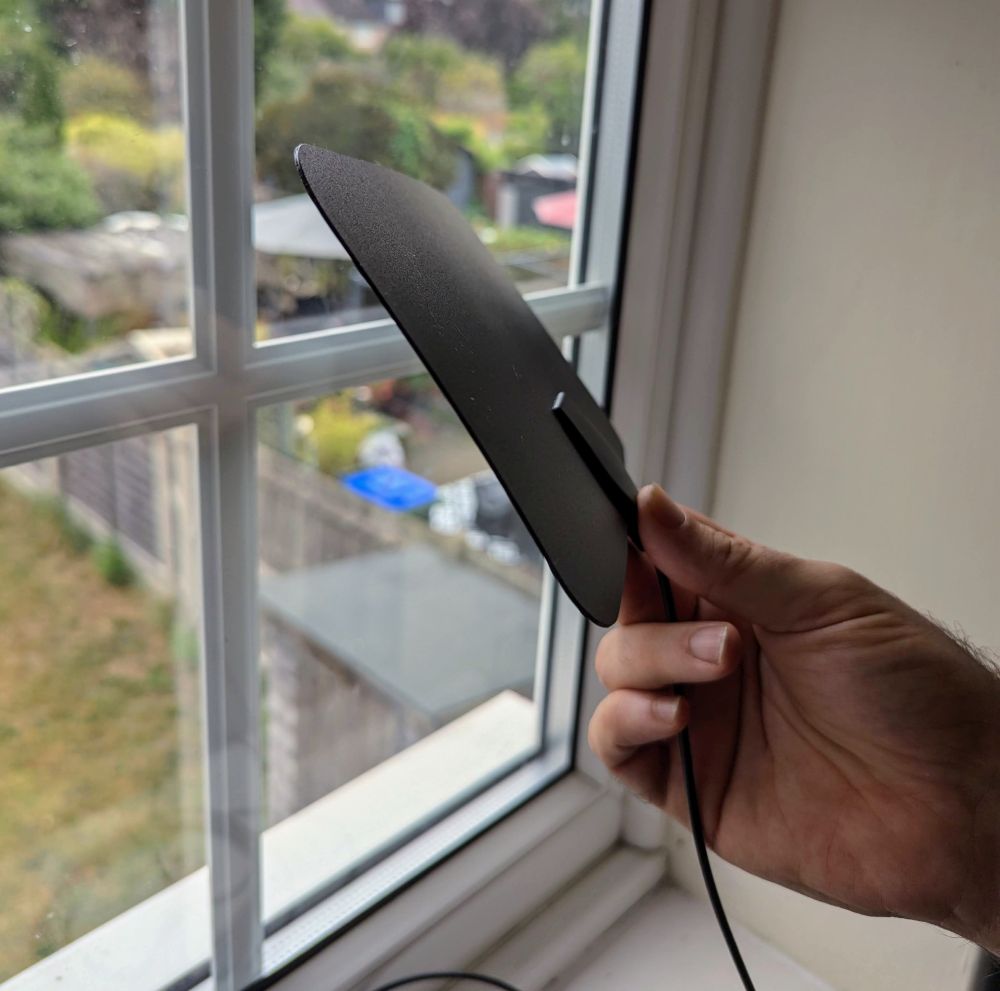
But that doesn’t make their plan worth ignoring – if anything, the opposite. Nobody knows this network better, and theirs is one of the few submissions that doesn’t just say “keep Freeview” but sets out a practical, costed way to do it.
With the government still undecided (as far as we know), a workable plan from the people who run the kit could very well end up being one of the options taken forward. So it’s worth understanding what they’re actually suggesting.
What Arqiva Is Proposing
The heart of it is simple: don’t rush. Arqiva wants Freeview kept running, alongside the growth of streaming, until at least the mid-2040s – a “hybrid” world where you can use an aerial, the internet, or both, and nobody’s forced off broadcast before they’re ready.
But they’re not arguing to freeze things exactly as they are. Their headline proposal is to modernise Freeview by moving it from six national multiplexes to three.
A multiplex, in plain terms, is one of the bundles of channels a transmitter broadcasts – think of it as a lane on a motorway, with several channels travelling along each one.
The UK currently runs six of these lanes. Arqiva’s plan would slim that to three from 2034, with one shared between the BBC and the other public broadcasters.
What would that mean for you? A leaner Freeview. Fewer lanes means less room overall, so the likely trade-off is a smaller channel line-up than today – though the plan is built around keeping the main, most-watched channels going.
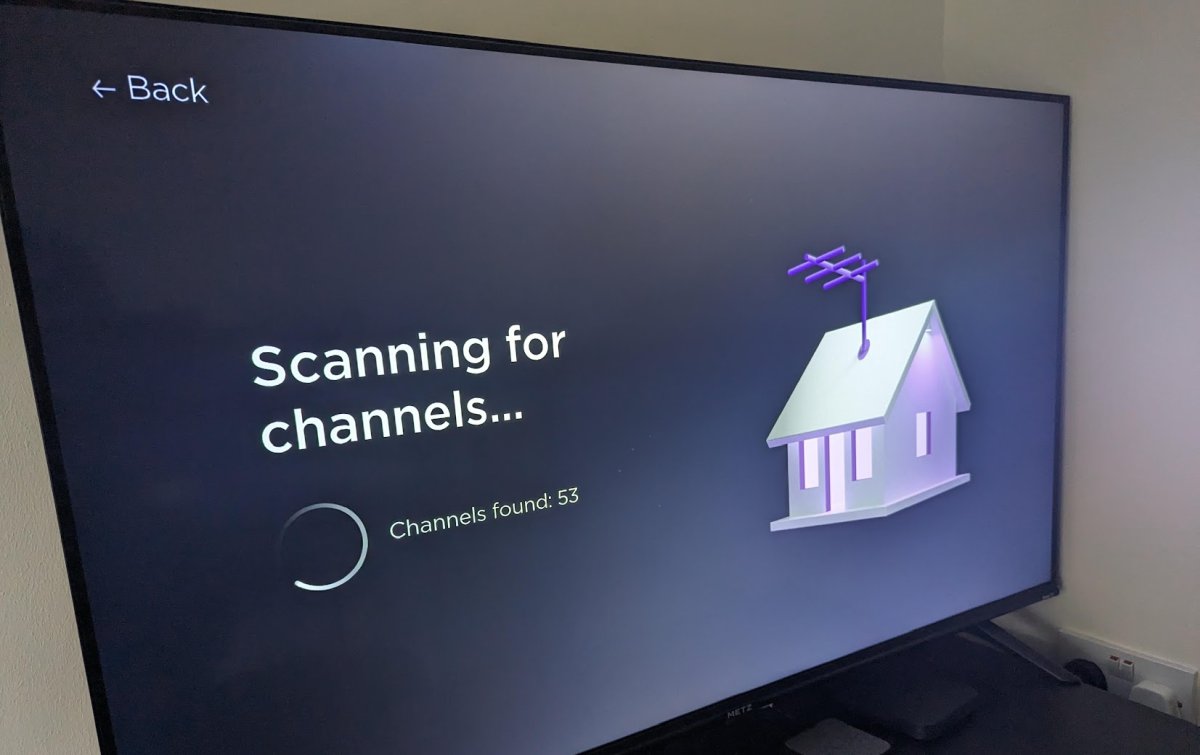
It’s a “Freeview survives, but trimmed” proposal rather than a promise that everything stays exactly as it is.
At the same time, Arqiva wants to upgrade the underlying technology to a more modern standard called DVB-T2 – the same broadcasting tech already used in France, Italy and Spain, which the UK has been notably slow to adopt.
The upside is better efficiency and room for more high-definition channels. The catch worth knowing: some older Freeview TVs and boxes don’t support DVB-T2, so a change like this could eventually mean replacing kit that can’t handle it – though a long transition timeline is exactly what’s meant to smooth that over.
Furthermore, the main argument for switching Freeview off is that it’s too expensive to run a broadcast network and pay for streaming at the same time – the BBC itself has said it doesn’t want to be stuck funding “two expensive distribution systems.”
Arqiva’s answer is essentially: it needn’t cost what you think. They reckon their slimmed-down, three-lane network would cut broadcasting costs by more than 40% while still reaching 98.5% of the country – the same near-universal coverage as today.
And according to independent analysis included with their submission, the net cost to the BBC of keeping it going could be as little as 1-2% of its licence fee income.
The pitch, in other words, is that keeping Freeview alive is far cheaper than the “we can’t afford both” argument suggests – which, if accepted, knocks away the main reason for switching it off in a hurry.
Why They Say We Shouldn’t Be In A Rush
Beyond the money, Arqiva leans hard on a point that’ll be familiar to anyone who’s read the comments on our previous Freeview articles: a lot of people still rely on the aerial, and they’re not the people best placed to cope with being pushed online.
Their figures make the case. Around 13.6 million homes still use Freeview, many as part of a mix alongside streaming. Some 4.9 million homes don’t have a TV connected to the internet at all, and 1.3 million have no broadband whatsoever.
Freeview on its own still accounts for close to half of all viewing of the main public-service channels. It’s a substantial chunk of the country. And it skews older: the UK’s population is ageing, and older viewers lean far more heavily on broadcast TV and radio than younger ones do.
This is where Arqiva’s argument runs up against the more optimistic forecasts – and the contrast is worth understanding, because both can’t be the whole story.
The research we covered recently, projecting Freeview’s fall to under a million homes, also reckoned the number of households with no broadband would drop to just 220,000 by 2034.
That’s a reassuring picture – but it’s a forecast, a projection of where things might go. Arqiva is pointing instead at the situation as it stands today: millions still without a connected TV right now, and real questions about how fast that changes.
The two aren’t necessarily contradictory – one is optimistic about the future, the other cautious about the present. But even the rosy forecast admits some people will still be left without internet TV. The question neither side escapes is what happens to those people.
Arqiva’s answer is the simplest one: don’t rush them.
Then there’s the cost-to-you angle, the one most likely to hit home. Right now, once you’ve bought a TV and an aerial, Freeview is genuinely free – no monthly bill beyond the licence fee.
Move everyone to streaming and watching “free” telly suddenly requires a broadband connection, at roughly £27 a month.
Arqiva puts it bluntly: forcing people to pay for broadband just to watch the BBC would amount to a subscription charge by the back door, whether or not that money ever reaches the BBC.
For a service whose whole justification is that it’s universal and free to use, that’s an awkward contradiction – and it’s a worry plenty of our readers have raised themselves.
Two more practical points round out their case. First, reliability: broadcast signals keep working in a crisis – storms, power cuts, emergencies – when broadband and mobile networks sometimes don’t, which is why the aerial network is built into the country’s emergency planning.
Second, radio. The same masts that carry Freeview also carry much of the UK’s radio, so switching off the TV side could push up costs for radio or even put some services at risk – a knock-on effect that ties directly into the separate review of FM radio’s future the government has already launched.
Where Does Freely Fit Into All This?
You can’t talk about Freeview’s future without talking about Freely, because Freely is what’s meant to replace it.
Freely is a streaming platform from Everyone TV – the organisation behind both Freeview and Freesat – designed to do the same job as Freeview, but over the internet instead of through an aerial.
You get BBC, ITV, Channel 4, 5 and a growing list of other channels in a single programme guide, with catch-up built in, and no aerial or dish needed. Like Freeview, the service itself is free; you just need broadband to use it.
When it launched in April 2024, there was a big catch: Freely only worked on brand-new smart TVs from certain manufacturers, so trying it meant buying a new telly.
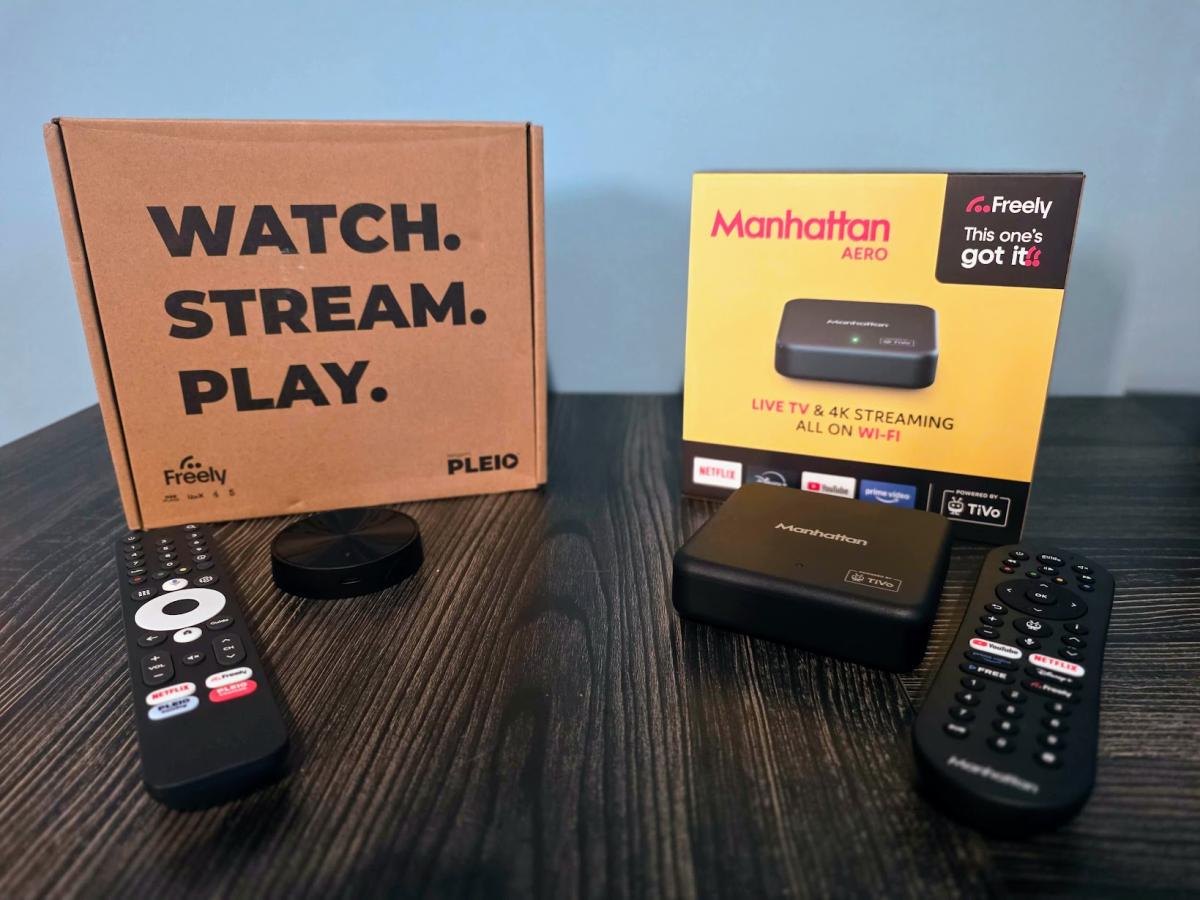
That’s changed over the past year with standalone Freely boxes that plug into any TV with an HDMI port. The Netgem Pleio now sells for £99, and the Manhattan Aero sits just below it at £89.99, so the gap between the two has narrowed to £9.
But Freely also helps explain why Arqiva is urging caution, because it isn’t yet a like-for-like replacement. It depends entirely on having decent, reliable broadband – no connection, no telly.
The standalone boxes are streaming-only, with no aerial fallback, so if your internet drops, so does your TV. It doesn’t let you record in the traditional sense – there’s a short live-pause buffer and that’s it.
And its channel line-up, while growing, is still smaller than the full Freeview list, with many smaller channels still needing an aerial.
For plenty of households Freely already works well; for others, the broadband, the cost or the missing features mean it isn’t there yet. That gap is the crux of the whole timing argument.
What Happens Next
None of this is settled. The submissions to the committee feed into a much bigger process: the government is working through the responses to its Charter Review and is expected to publish its conclusions later this year, with a draft Charter going through Parliament before the current one expires on December 31, 2027 and the new one taking effect on January 1, 2028.
Separately, the green paper on the future of TV distribution – the document that will actually set out the conditions for any Freeview switch-off – is expected soon.
The future of Freeview is only one piece of all that, and the government has given itself room to move slowly: broadcast TV is currently protected until at least 2034, with campaigners pushing for 2040 or beyond.
Arqiva’s mid-2040s hybrid plan sits squarely in that “don’t rush it” camp.
The thing to take away is that this isn’t just lobbying for its own sake. Arqiva has a clear stake in the outcome – but it’s also one of the few voices to put a specific, costed plan on the table rather than simply picking a side.
With ministers still undecided on which road to take, a proposal from the company that runs the transmitters is one that could realistically end up shaping what happens to the aerial on your roof.
For more news about Freeview, Freely and TV, Sign up for our free e-mail newsletter.
How about this for Freely’s confidence in their own product at the time of the world cup where they encourage everyone to buy a new telly? Station #3 was always ITV1 HD streaming version until recently where they swapped it out for the aerial version (which was at #233). They have now hidden the streaming counterpart away at #811. No doubt to pre-empt complaints about the broadcast lag, a major problem with live TV sports via streaming.
This topic came up at the SCTE streaming conference this week.
The world cup is happening thousands of miles away. There’s unavoidable latency on every platform, both from distance and encoding. Even analogue signals had some latency.
The biggest problem is that the latency is not the same on every platform.
Reducing streaming latency is a good aim and plenty of tech in the works (like Media-over-Quic) will do just that in the coming years
But aligning it is arguably more important, especially across multiple devices in the same household. That’s potentially a tougher challenge.
At the core of this is the false assumption that so-called PSBs on Freeview are must-have services, which no household could do without.
But in reality the UK’s most popular content is no longer provided through terrestrial TV.
The remaining programmes appeal to an increasingly narrow and shrinking demographic. Anyone outside of this must already pay for broadband and/or subscription services to access their preferred content.
Once the myth of PSB is dispensed with, there is no reason why special provision should be made for those watching the broadcasters currently on Freeview, either by maintaining outdated linear broadcast signals, or by giving them free broadband, just so they can continue watching a particular set of programmes.
Indeed the Freely service sounds very much like Project Kangaroo, blocked (quite rightly) in 2009 by the UK Competition Commission on the basis that a joint video-on-demand service run by BBC, ITV and Channel 4 would have given those broadcasters too much control in the market.
A fairer solution is to simply ensure free or discounted broadband is available to those in financial hardship, allowing them to choose from a broad range of content, like the rest of us already do.
The so-called PSBs should be competing in this free and open market, without special treatment or, in the case of BBC, coerced funding from Licence Fees.
I think efforts would be better focused (i.e. money spent) on improving access to Freely for vulnerable groups than attempting to sustain something with a diminishing installed base.
I like recording too, but no reason apart from blocking from broadcasters that Freely couldn’t do that too (and better with higher bandwidth).
All free view boxes since 2010 will be DVB T2 ready. Not convinced there will be many 27-year-old boxes around in 2036. Still, stand by for some Daily Mail disaster stories about granny loosing her favourite programmes.
Ideally if Freeview was to disappear, it should be a phased closedown. Start with removing the small fill-in transmitters and helping out those who are affected by that.
Leave the large TX sites (Crystal Palace, Sutton Coldfield, etc) as the last to be shut down… and even then, do It by mux, leaving the BBC, ITV, 4 & 5 channels to be the last to go.
Arqiva have a good plan. Do away with the repeats and sd channels and have hd quality only.
i’d rather have quality rather than quantity.
On a bonus, we can record them and skip the adverts.
Access to space is getting cheaper by the year. Freeview should be ditched. Anyone who doesn’t want broadband then a Freesat alternative can be operated at much lower cost than freeview.
The Freely service needs to be available as an app on more devices without forcing people to upgrade hardware.
We need to modernise these systems and not get stuck in the past by companies lobbying the government to serve their own interests.
You can guarantee freesat will still be going in 10 to 20 years can you? I think their future is still very unsure. The cost of launching satellites into space is still expensive.
As for companies serving their own interest what about Sky who is on the other side of the argument? They want the existing freeview Ariels shut down asap.
There are apparently 1.3 million homes with no broadband. So at aprox £300 per year for a broadband contract x 1.3 million households that’s quite a lot of extra revenue for Sky and BT to tuck into every year just so people can watch so called “free to air” tv. No self interest there then?
I did a relevant post on Linkedin about this a few weeks ago – and here is an excerpt from that:
A common talking point is that households without broadband would be forced to pay for it if traditional broadcast platforms were withdrawn. That concern is warranted – but there’s an aspect few are considering:
👉 Internet access isn’t just about TV
The government has repeatedly framed digital infrastructure as now being foundational to society and the economy. In setting strategic priorities, the Department for Science, Innovation and Technology emphasises continued investment in gigabit-capable connectivity and digital inclusion to support economic growth and access to services nationwide – with an explicit role for broadband as a building block of modern public services and competitive markets. This is about a digital NHS, tax, benefits, and access to employment more than it is about TV.
Ofcom’s latest Connected Nations data shows that 98% of UK residential premises have access to “superfast” broadband, and gigabit-capable coverage continues to rise. While Openreach’s PSTN switch-off is focused on migrating voice telephony to IP, it does also mean the number of homes without access to an IP connection capable of supporting core digital services and a basic TV stream is now quite limited.
So if government concludes that some intervention is required to sustain universal access to public service media, the question becomes how that is delivered. A coherent policy direction would be to align any support with the existing broadband agenda – building on digital inclusion, capacity expansion and targeted affordability measures. That could take the form of a limited subsidised baseline broadband provision, potentially anchored on a tightly defined set of essential services (public service media, government platforms, health services), either bundled with any phone line or targeted at those unable to afford it.
– Paul Markham / @mediatechpaul
Yes agree with your points but. I live in Cumbria we were the test area for Digital TV. It was great when it came in but we didn’t get all the channels the rest of the country got because the commercial operator decided the population was too small for it to be viable. That remains the case today. The same is happening with broadband role out despite all the claims being made for Digital inclusive. It is the low hanging fruit that is dealt with as a priority not the people who most need it whose local services have been decimated over the last 30 years. This is a commercial decision not an equitable one. So all the services you list as going over to the Internet and require good broadband are lost to those people in rural areas and TV to the list.
By the end of 2026 all landline phones will be full fibre and voice over IP. This means anyone currently with a landline phone will have been switched to broadband connection. Freesat has more HD channels than Freeview and more channel choice. I have switched to iPlayer and catch up services and no longer use a television or FM radio.
Anyone with a Freeview TV has digital radio so there is 98% coverage. The expensive to run FM and DABs networks can also be switched off. I have switched over to internet radio for more choice and no interference. My car’s DAB in poor weather is useless and FM is as bad as AM radio without the traditional aerial. I could use my phone to access internet radio in the car.
Currently there is the issue of no power means no phone service and if free to air TV is only via streaming over broadband no access to service broadcasts either. But that is also why 5G coverage is needed.
Freely currently needs a new TV or a set top box. Why can’t this be accessed online like YouTube, streaming services and catch up services like BBC iPlayer and All4 via a browser or an app?
What Arqiva don’t tell you is the amount of money they still owe to their former owner, Macquarie Bank. Yes the same vultures who did a similar number on Thames Water.
Macquarie have a simple playbook: buy critical public infrastructure at a discount. “Invest” in it (by which they mean load it with debt owed to them, they’re a bank!), use that same money to pay themselves juicy dividends (as they’re the owner) and then eventually sell it on, with the debt intact.
When that scheme goes well for them, as it did with Thames Water, they make their money back 3 times (dividends plus sale plus debt) with interest on top.
It didn’t go so well with Arqiva as they had to sell there share recently at a massive discount, but nevertheless Arqiva still has a big debt pile with them and it’s still making them money overall.
Where am I going with this?
Oh yes, Arqiva dresses its concerns up as inclusivity with the cover of well-meaning organisations like silver voices . But fundamentally this is the begging bowl out for British public money to keep the wealth trickling up to Australian-based vulture capitalists.
Yes we need to make sure everyone can access public service TV-that’s both a distribution issue and a usability issue. But if we’re going to spend public money let’s subsidise broadband for the vulnerable. Let’s improve user experience for the elderly so online TV is indistinguishable from old TV. Let’s invest in the future, not in sustaining the past. And certainly not in sustaining the questionable private finance schemes of the 1990s.
Totally agree, and the key point you make is “improve user experience for the elderly so online TV is indistinguishable from old TV”. Freely is still a bit of a mess UI-wise.
Why can’t the programme guide be implemented more like the Sky one? The whole UI is much too modal and that makes it very confusing for the oldies.
I don’t condemn it entirely – it is not totally awful – but someone at Freely needs to spend some time refining it, making it simpler and less confusing.
I’d support getting rid of Freeview, but only on the condition that the Licence Fee is ditched and replaced by a streaming fee, which can be around about the same price as the current Licence Fee. We also need the internet to be as reliable as terrestrial telly currently is. Do that and I’d say let’s ditch Freeview, but if the Licence Fee is to remain, then so should Freeview. No way should we be forced to pay two lots of bills! Admittedly, many do pay both and are very happy to do so, but not everyone can afford to and shouldn’t have to.
For me, the problem with Freeview is that the non-HD channels are almost unwatchable because the picture quality is so bad. The idea of streamlining and allowing for more HD channels is good, I think.
Interesting this, one repeated complaint you hear about TV at the moment is the amount of repeats, and little new content TV currently seems to be more about technology, what with smart TV’s streaming boxes etc. and less about programme content. Aquiva propose fewer channels hopefully this should reduce the so called “specialist” channels, while increasing the number of HD channels. An interesting observation looking at the Argos webb site and the new Manhattan Freely streaming box in particular, most customer reviews are submitted by the age 65 and over group which suggests the very group that people are concerned may be left behind in the proposed switch to this new technology are in fact the ones embraceing it.
They say that freeview covers 98.5% of the country but in reality, especially where I live, the signal keeps dropping out. So much so that I changed to Freesat but with that not guaranteed after 2029 I went out and bought freely box and am very happy with that
The problem is they don’t want to operate two different free to air distribution systems but they aren’t really making it easy to access Freely for most people unless they buy a new TV. The two options for Freely boxes are manufactured in such low quantities and at only a handful of online retailers most people are probably not even aware they are an option.
They don’t even advertise Freely that much in comparison to when Freeview and digital TV in general so it’s not like they are actively pushing for it to replace what people are already using.
Then you have the inconsistent quality of the channels and the fact that many people who still use free TV don’t want to switch until they absolutely have to because they will lose certain features like the ability to record what they want and not have to rely on an always online connection to actually watch those shows.
Arqiva makes a very sound case for a trimmed Freeview using DVB-T2. We should have made that move years ago. But just like delivering other national infrastructure projects, our Governments have shown themselves to be pretty useless. Nobody should be forced to pay for broadband to watch TV!
Excellent proposal and we will still be able to record
DVB-T2 equipment has been on the market since before analogue TV switch-off. That’s 14 years. I think most people will have done at least one upgrade since then and if they didn’t get DVB-T2 ready equipment , more fool them. It’s the same with DAB radio. DAB+ radios are sold amongst old flavour DAB sets and anyone who buys those non-DAB+ sets is not future-proofed and didn’t listen to advice unless it was bad.
Excellent proposal by Arqiva for Freeview