
Freely, the broadband-based platform being lined up to replace Freeview, has just had its biggest moment since launch – and it has the World Cup to thank for it.
New figures from Everyone TV, the organisation behind the platform, show a sharp rise in the number of people who streamed this summer’s tournament over the internet rather than through an aerial.
It’s the kind of number that lands at a very convenient time, with the government now openly planning to eventually switch Freeview off and move the country onto internet-delivered TV.
So let’s go through what the data actually says, and what it tells us – and doesn’t tell us – about how close we really are to the end of the aerial.
What The New Figures Show
The standout figure comes from BARB, the UK’s official TV measurement body, and it covers England’s three group-stage games.
The share of viewing that came from broadband-only homes – people watching over the internet rather than through an aerial or dish – was 473% higher than for the 2022 World Cup. That’s more than five times the level of four years ago.

Everyone TV paired that with a set of milestones for Freely itself, drawn from its own internal data.
The platform passed two million monthly active users in the week beginning July 6, and recorded its most daily active users on Sunday July 19, the day of the final.
The company also says more users are returning to Freely daily than a year ago, which it puts down to growing loyalty.
Jonathan Thompson, chief executive of Everyone TV, said major sporting events bring millions together for a shared live experience, and that compared with 2022, significantly more of that viewing took place over the internet – which he framed as evidence of broadband’s growing role in delivering free television.
A Quick Freely Reminder
If you’re new to any of this, here’s the background.
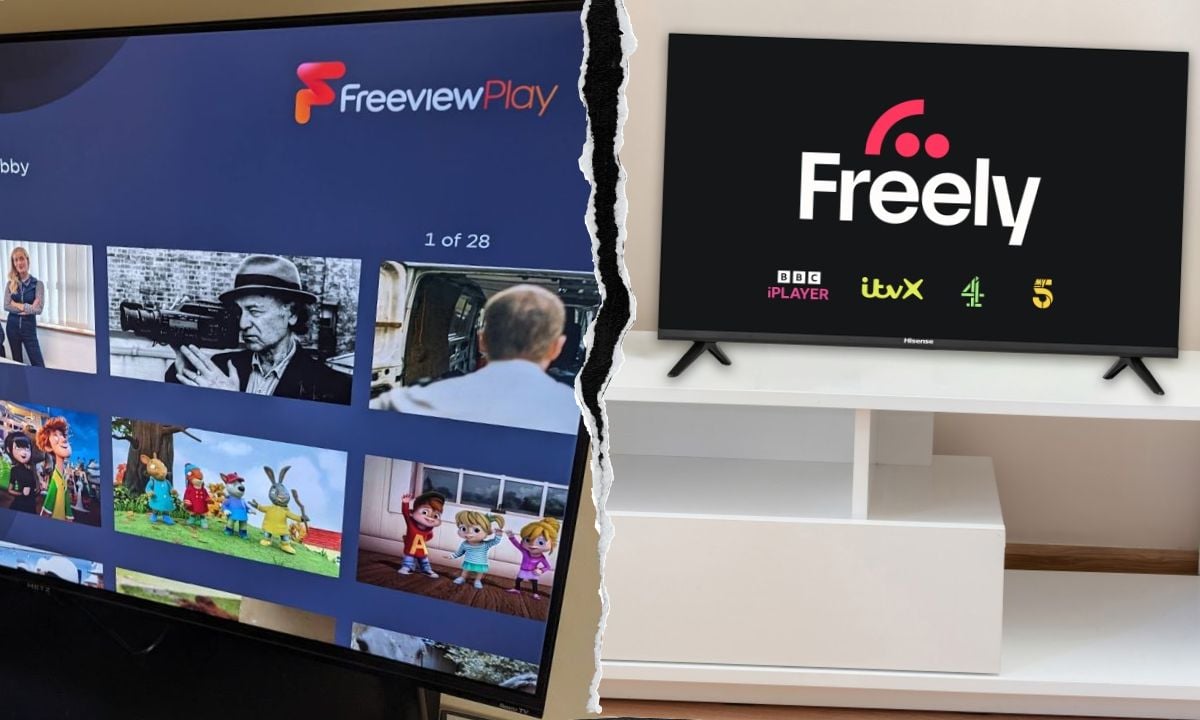
Freely is Everyone TV’s streaming platform – and Everyone TV is the same organisation behind Freeview and Freesat. Rather than pulling channels in through an aerial or a satellite dish, Freely delivers them entirely over your broadband connection.
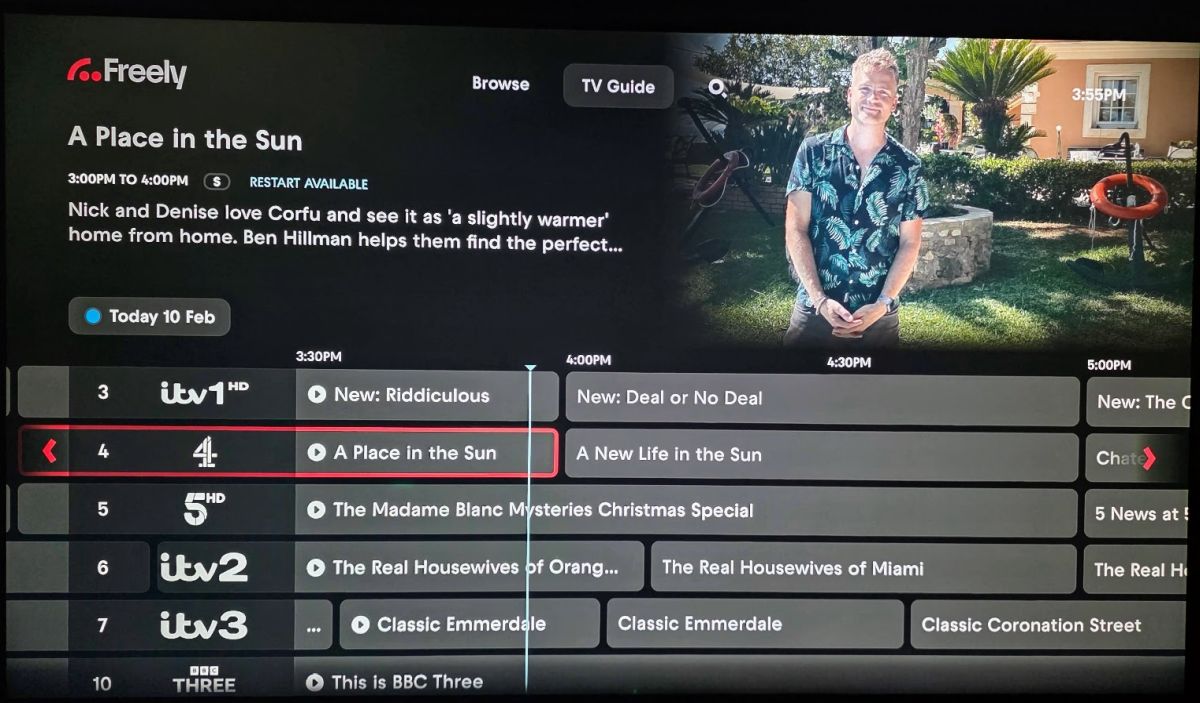
You get BBC, ITV, Channel 4, 5 and 60-plus other channels in a single programme guide, with seven days of catch-up built in. The whole thing is free, with no monthly cost beyond the TV Licence.
It launched in April 2024, and for the first 18 months you could only get it by buying a new smart TV with Freely built in, from brands like Hisense, Panasonic and Amazon Fire TV.
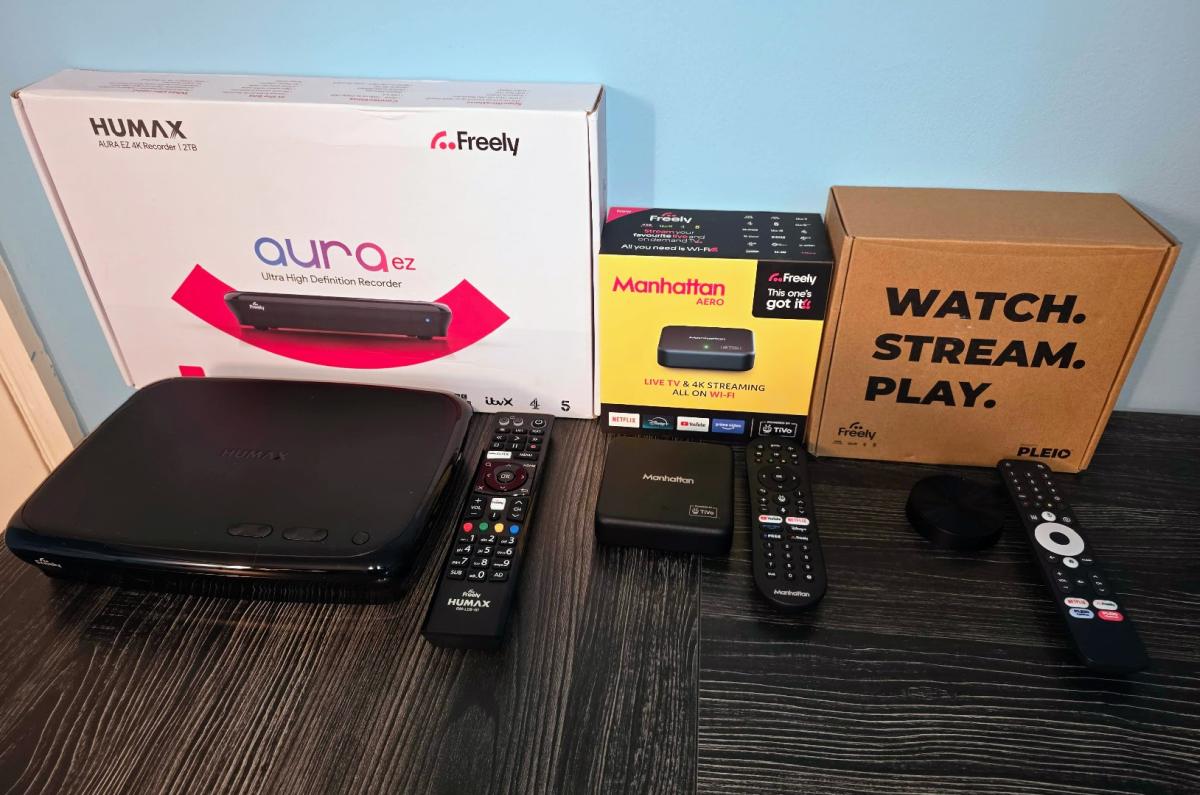
That changed in November 2025 with the first standalone box – the Netgem Pleio, at £99 – which brought Freely to any TV with a spare HDMI port. It’s since been joined by the Manhattan Aero at £89.99, and the recording-capable Humax Aura EZ at £249.
Both the BBC and ITV showed the World Cup free-to-air this summer, split between them, with all 104 matches available on BBC iPlayer and ITVX.
Since both broadcasters are already part of Freely, the platform carried the entire tournament without anyone needing a subscription.
Why The Numbers Matter – And How To Read Them
Two million monthly users is a genuine milestone, and the pace is the striking part. Freely passed its first million around December 2025, having doubled from 500,000 in a matter of months.
Doubling again to two million by July puts it on a steep curve, and lines up with forecasts from analysts 3 Reasons that Freely will be the UK’s largest TV device platform by 2030, in 7 million homes.
The 473% figure needs reading with a bit of care, though. Freely didn’t exist in 2022 – the Qatar tournament finished in December that year, well over a year before the platform launched.
So the 2022 baseline for broadband-only World Cup viewing was small to start with, a handful of people watching on smart-TV apps or their phones.

Rising to five times a small number still leaves you with a number that isn’t necessarily huge, so it’s a real shift, but a percentage like that always looks more dramatic than the underlying change.
The two tournaments weren’t like-for-like either. Qatar 2022 was a winter World Cup, with England’s group games kicking off at comfortable UK afternoon and evening times.
This year’s tournament, hosted across the United States, Canada and Mexico, pushed a lot of games deep into the night here. That arguably makes the streaming shift more telling, not less – people moved online despite the unsocial hours, not because the timings made it easy.
And the record viewing day, landing on the day of the final, is roughly what you’d expect from a fast-growing platform – a two-year-old service doubling in size tends to set its record on its biggest event.
The fairer point is that a record day is also a stress test, and Freely appears to have handled the load. For something being pitched as a replacement for the entire terrestrial network, that counts for something.
What About The Lag?
There’s a specific worry that comes up a lot with streamed sport, so it’s worth addressing: lag.
Live TV over broadband runs slower than the same channel through an aerial or dish. A traditional signal might show you a goal within eight to ten seconds; a stream can trail 30 to 40 seconds behind.
That’s easily enough time for a neighbour’s cheer through the wall, or a goal alert on your phone, to spoil the moment. Freely carries the same built-in delay as any other stream, so it’s not exempt.
The encouraging bit is that this is being worked on. During the tournament, Sky rolled out a feature called Real Time on its Sky Glass and Sky Stream boxes, cutting the delay on the BBC and ITV World Cup coverage – to the point where, on Sky’s own hardware, those free channels could actually reach you quicker than opening iPlayer or ITVX directly.
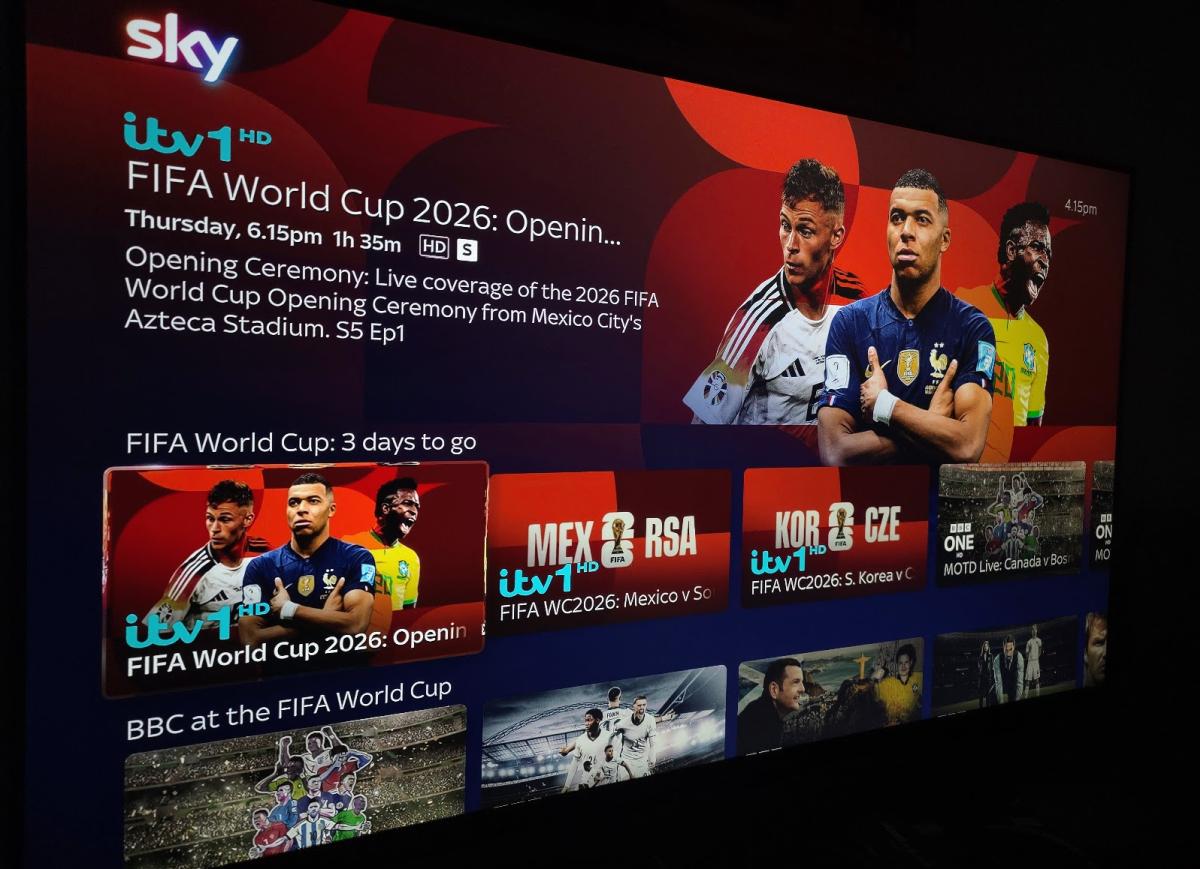
Sky can do that because it controls the whole chain, hardware and software; the BBC has been chasing the same goal for iPlayer, but has to cope with far more devices it doesn’t control.
Nobody has announced a super low-latency feature for Freely yet. But Sky’s effort shows the lag is a solvable engineering problem rather than a permanent fact of streaming, and it’s fair to expect the gap to narrow over time, whether through Freely or the broadcasters’ own apps.
What This Means For The Freeview Switch-Off
Last month the government published its green paper on the future of free TV, and made its preference plain: it wants Freeview switched off as soon as December 31, 2034, with a longer option running to 2044 as the alternative it’s “seeking views on.”
The consultation is open until 11:59pm on August 31, with a final decision promised later this year. A strong set of World Cup viewing numbers, landing right in the middle of that window, is a handy piece of evidence for the direction Everyone TV wants this to go.
And that’s the thing to keep in mind: Everyone TV isn’t a neutral observer here. It runs Freely, Freeview and Freesat all at once, and sits on the government’s Future TV Taskforce, which has already backed the earlier 2034 date. When it publishes research showing broadband viewing on the rise, it’s supporting a transition it’s also helping to steer.
The numbers themselves fit a pattern we’ve written about plenty. The forecasts all point the same way – Freeview shrinking from 9.7 million main sets today to under a million by 2034, Freely climbing past 10 million in the same period – and the honest reading of that is double-edged.
The smaller the group left relying on an aerial, the more reassuring it sounds, but it’s also the exact argument for switching off sooner rather than later.
If barely anyone still needs the transmitters, why keep funding the whole network for them, rather than spending a fraction of that helping them get online? A forecast that fewer people will be stranded is quietly also a forecast that the old system is easier to pull the plug on.
What these figures don’t touch is the stuff that actually worries some of our readers about the switch.
Cost is the big one: for anyone who doesn’t otherwise want the internet, broadband is a new bill of roughly £27 a month, on top of the licence fee, to keep watching telly they currently get for free – and the green paper pointedly makes no promise of public money to help, unlike the analogue switchover, where the state did chip in.
Recording is the other: Freely still can’t do it, catch-up isn’t the same thing when programmes vanish as licensing deals expire, and the green paper barely acknowledges the loss.
And Freesat viewers, many of them rural with patchy broadband, have been left waiting on a separate transition plan that doesn’t exist yet.
But either way, this summer’s football tells us something real – more people are happy to stream live TV, even the biggest events, even at antisocial hours – and it’s a major marker of momentum.
For more news on Freely, Freeview and the future of free TV, Subscribe to our free newsletter.
With reference to the problems about relying on the internet when Freeview and Freesat are switched off (see below):
Currently Freely is a hybrid service of internet plus Freeview.
Hopefully, when Freeview is switched off, Freely will become a hybrid service of internet plus “5G Broadcast”.
Would like to be able to get the Freely App on my Amazon Fire TV Cube !
The worst thing is to rely on broadband for everything last year our BB went down for 6 days plus No tv Radio phone smart devices door Bell terible
Worst thing in doing everything in one basket
I have freesat free view and broadband for Netflix ,if I only had broadband I have 2 boxes one for the fibre going to the hub.There are 3 points of failure the broadband company the box for the fibre and the hub box. Freeview and freesat are would be a good back ups with less to go wrong.Im glad I have a huge section of blu rays and a few blu players if we have to rely on freely.
We have just experienced a 2 day broadband outage due to Openreach incompetence and subsequently 2 days recovering with various resulting WiFi issues caused by the various attempted diagnostic actions driven by EE/BT. We have 3 TVs using WiFi and Internet for catchup TV and 4K
Contrast that with (to date) 100% reliable Freeview and Freesat.
I dread being totally dependent on the internet to deliver our TV. Definitely a case of “ensh**ification” – (its a real word – look it up on Google! :-).
Our local WhatsApp group is almost daily reporting some sort of broadband outage.
I’m happy to have internet TV as an alternative eg for 4K or catchup but PLEASE leave us with a TV service that is 100% reliable and comes up in a matter of seconds with one press of the remote without passwords, multiple menu navigation and sync delays.
This has got to stop. Man the barricades.
(Ok we did get a 2 second blip to Freesat when a plane flew through the signal path!!!)
And of course there are those forgotten people with rubbish broadband speed that dont live in that there city !
I wonder how many people did what I did press the red button while watching bbc 1 via my aerial to then watch in uhd via the bbc iplayer thereby contributing to a sharp rise in those watching via the internet
I wonder how many people did what I did , while watching bbc1 via my aerial I pressed the red button to watch in uhd via the internet.
Very disappointed since buying a Freely box as I was expecting the same number of channels as Freeview. However this is not the case as there are way less on Freely.
If you can plug an aerial into your Freely device, then Freely should add the Freeview channels to the Freely channels.
If you re-scan Freely now, you’ll get eleven more channels (about 148 in total).
They are all extra “Channel Five” channels (including Milkshake for children).
TV license is the equivalent of £15 a month at the moment.
Social tariff broadband is £12.50 a month at the moment.
Therefore if TV license was scrapped when freeview ends, it could potentially be cheaper for those who were due a license and didn’t have broadband.
Plus of course theres many other benefits of having broadband such as online shopping, getting groceries delivered. Being in contact with people across the world easily. With TV along you then have the option of on demand, online streaming, catchup, and the various services like Netflix, Disney, Prime, Apple, as well as iPlayer and many other free options.
Plus when you take into consideration that the TVL usually increases over time and the cost of broadband is typically reducing over time, the savings to most people are going to be greater if people are no longer paying for TVL and they already have broadbant
You must be living in fantasy land if you think the tv licence fee is going to end anytime soon.
Of course the benefits of broadband are obvious to most people. They are not the issue though. It is a small number of people who are mostly older and though incomprehensible to people like you don’t want broadband or extra expense as they don’t use computers, and never have done. My elderly dad can barely use a basic mobile phone. These people managed just fine all their lives without it and lived productively and quite happily.
I realise that soon these people will all be gone, and the rush to broadband nirvana will be unleashed (well until there is a power cut or broadband outage.)
I’m always fascinated by how the people who demand tolerance from others are always remarkably intolerant to those who don’t buy into the latest central planning utopia.